Apply For Shluchim/Wholesale Account Here


Hanukkah Menorah Meaning: History and Symbolism

At a winter gathering, a single flame appears in a public square, then another, and another, until the hanukkiah becomes the brightest point in the scene. People pause, children count the lights, and a private ritual becomes a shared act of memory.
Table of Contents
- Defining the Hanukkah Menorah and Its True Name
- Historical Origins and the Evolution of the Design
- The Anatomy and Ritual Mechanics of the Hanukkiah
- Publicizing the Miracle Through Visibility
- Comparing Traditional Candles and Modern LED Displays
- Selecting the Right Menorah for Your Venue
- Preserving the Legacy of Light in Modern Communities
Defining the Hanukkah Menorah and Its True Name
The object many call a Hanukkah menorah is more precisely a hanukkiah, or chanukiah. That distinction matters because the ancient Temple menorah and the Hanukkah lamp serve different ritual purposes and have different designs.
The Temple menorah was the seven-branched lamp associated with the Temple in Jerusalem. A hanukkiah, by contrast, is made for Hanukkah and has eight lights for the festival's eight nights, plus a ninth helper light called the shamash. The extra light isn't one of the nightly lights. It helps kindle the others and remains functionally separate from them. My Jewish Learning explains the difference between the Temple menorah and the Hanukkah hanukkiah.
That nine-light structure carries the central hanukkah menorah meaning. The eight principal lights recall the tradition that one day's supply of oil burned for eight days while new oil was prepared. The shamash makes the ritual workable, but it also reinforces the idea that the sacred lights are set apart from ordinary illumination. The hanukkiah isn't a decorative Jewish symbol. It's a purpose-built ritual object that tells a story through its shape and use.
Why the name helps explain the symbol
In everyday speech, “menorah” is widely understood, and using the term isn't necessarily confusing in casual conversation. Still, precise language helps newcomers, educators, event planners, and public institutions label displays correctly. A seven-branched Temple menorah represents the Temple lamp, while a nine-branched hanukkiah represents the Hanukkah observance.
A public display can make this difference visible immediately. When viewers see eight aligned candle positions and a distinct shamash, they're looking at a lamp designed for the eight-night progression of Hanukkah, not a replica of the ancient Temple menorah. This guide to the difference between the Temple menorah and the Hanukkah menorah offers useful background for communities preparing educational signage or event explanations.
The terminology also protects the ritual meaning from becoming flattened. The hanukkiah remembers Jewish victory, Temple restoration, endurance, and the oil tradition through one repeated action. Its form is the first lesson. Its lighting sequence completes the message.
Historical Origins and the Evolution of the Design
A community gathers around a hanukkiah after sunset. The lights are small, yet they make an ancient story visible to everyone passing by. Hanukkah commemorates the rededication of the Temple in Jerusalem after Jewish Maccabees reclaimed it from the Seleucids in 164 BCE. The eight-day celebration preserves that historical memory, while later rabbinic tradition connected it with the oil miracle that shaped the candle-lighting practice. Britannica's overview of Hanukkah explains the relationship among the Temple's rededication, the Maccabees, and Hanukkah's central lighting ritual.
The hanukkiah did not appear as a finished design at the moment of the revolt. The first celebration focused on restoring and rededicating the Temple. Across later centuries, the lighting practice developed into eight festival lights accompanied by a shamash. Historical accounts cited by Britannica place evidence for this development in the 2nd century CE, followed by greater standardization in metal and clay during the Middle Ages. Britannica's account of Hanukkah's origin traces the progression from historical event to established ritual object.

A layered historical memory
The design holds several memories at once:
- Temple restoration: The lamp recalls the rededication of Jerusalem's Temple after the Maccabean victory.
- Oil and endurance: The eight lights express the tradition that a limited supply of oil continued burning until more could be prepared.
- Ritual development: The nine-light form reflects a practice clarified over centuries, rather than a design preserved unchanged from the revolt.
This history keeps the hanukkiah from becoming a generic seasonal ornament. Its arrangement records religious survival. Each added light connects a present-day household, synagogue, or public gathering with a Jewish tradition shaped across more than two thousand years. The object's form turns history into a repeated act of remembrance.
From oil lamps to contemporary displays
Early versions of the practice could use simple clay vessels. Later communities adopted more durable materials and recognizable candelabrum forms as the ritual object became more standardized during the Middle Ages.
Modern hanukkiot may use metal, ceramic, wood, or illuminated components. These changes respond to different homes, courtyards, streets, and civic spaces without discarding the older meaning. A family heirloom, a tabletop lamp, and a large outdoor installation can all express the same eight-night progression.
The ancient instruction to publicize the miracle helps explain the scale of contemporary displays. A public hanukkiah carries the private ritual into a shared setting, where its growing row of lights can serve as a visible reminder of rededication, endurance, and Jewish identity. For organizers, the structure is therefore more than a decorative choice. It is a practical way to make a long religious memory legible in modern community life.
The Anatomy and Ritual Mechanics of the Hanukkiah
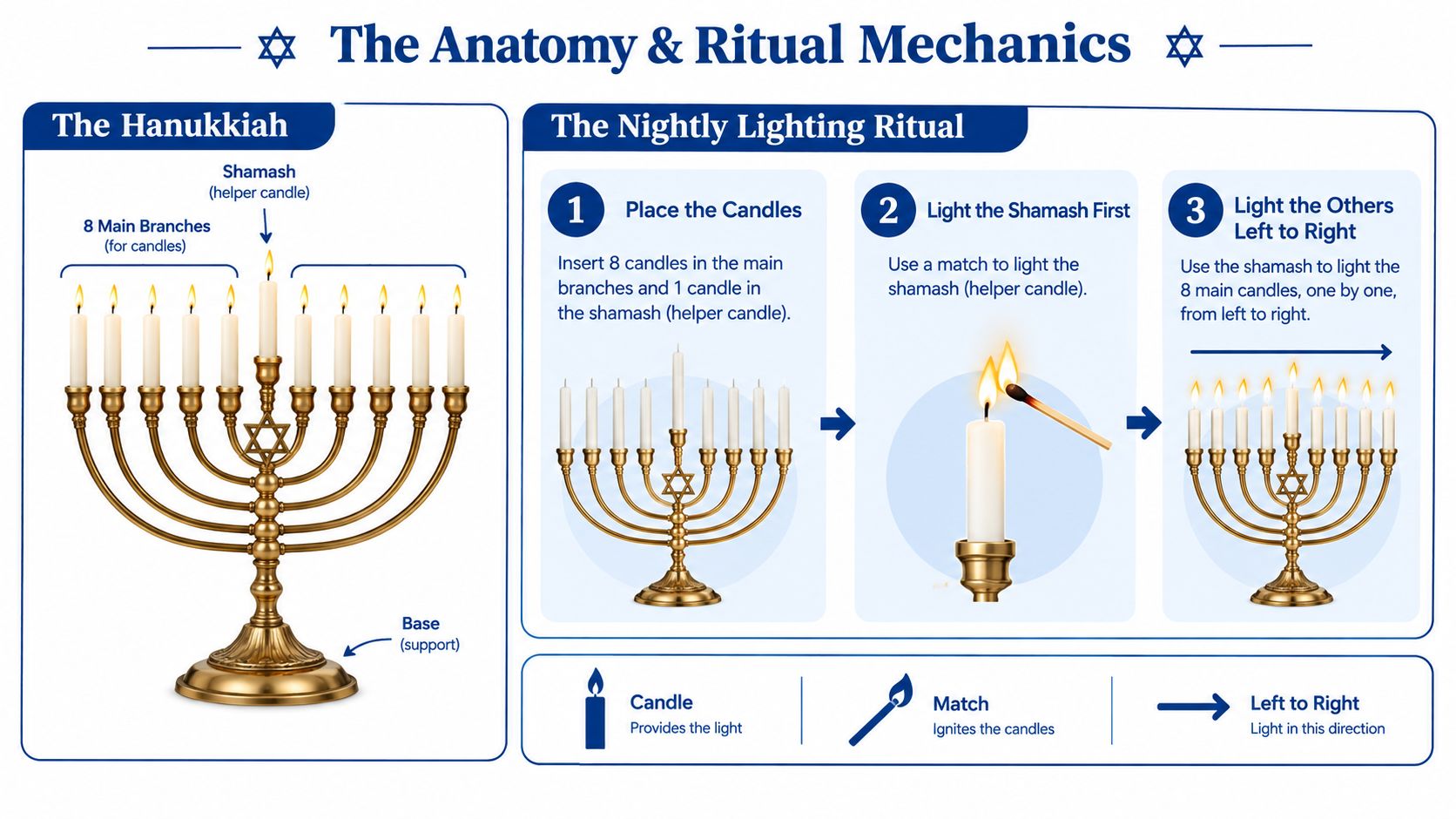
A hanukkiah has a stable basic anatomy. It includes a base, eight positions for the festival lights, and a separate position for the shamash, the helper light. The shamash may stand higher than the others, sit apart from them, or be distinguished through another design feature. Its physical separation clarifies that it serves the other lights rather than counting as one of the nightly lights.
The separation also has a practical purpose. The ritual lights are for remembrance and proclamation, not ordinary use, while the shamash supplies the flame used to kindle them. This explanation of menorah branches and their arrangement can help households and institutions identify the functional parts before lighting.
Placement and lighting order
The sequence often causes confusion because placement and lighting move in opposite directions. The candles are inserted from right to left. On each night, the new candle goes beside the candles already placed, extending the visible progression across the hanukkiah.
Lighting begins with the newest candle, moving from left to right. The shamash is lit first, and it kindles the festival lights in that order. The newest light receives priority because it marks the increase associated with that night. This Jewish educational explanation of the Hanukkah menorah's use explains the relationship between right-to-left placement and left-to-right lighting.
A simple way to remember the process is:
- Place the candles from right to left. Put the first candle on the right, then add each new candle beside it.
- Light the shamash. Keep it distinct from the eight principal lights.
- Kindle the newest festival light first. Continue toward the older lights.
- Allow the ritual lights to serve their commemorative purpose. Don't treat them as ordinary task lighting.
For a large public installation, organizers must translate this sequence into equipment controls, safety procedures, and a clear ceremony. A display can be visually impressive while still requiring careful attention to which lights represent the ritual progression and which light functions as the helper.
The mechanics aren't a minor technical detail. They express the logic of the holiday. The hanukkiah doesn't show all its light at once. It builds, night by night, making continuation and increase visible.
Publicizing the Miracle Through Visibility
The hanukkiah's meaning extends beyond the room where it's lit. Jewish law sources connect the ritual with publicizing the miracle, commonly known as l'farsumei nisah. The lamp should be placed where it can be seen from outside the home, turning private observance into an outward declaration of memory. The Jewish Theological Seminary's guide to the laws of Hanukkah discusses visibility, placement, blessings, and the nightly increase in lights.
A window-facing hanukkiah makes the principle easy to understand. The household lights the lamp for its own observance, but the placement allows passersby to recognize that Hanukkah is being marked. The light communicates without requiring a conversation. It says that the story of Temple rededication and endurance remains present in the community.

Why public installations are religiously meaningful
Large outdoor displays in parks, city squares, shopping centers, synagogues, hotels, and civic spaces follow the same underlying logic at a different scale. A tall illuminated hanukkiah gives the increasing lights a shared public setting. It lets a community gather around the ritual, while people who aren't attending can still see the display.
Visibility is part of the message, not an accessory to it.
That perspective changes how organizers approach a public lighting. The display needs a clear sightline, a stable location, accessible controls, and an explanation that helps viewers understand what they're seeing. Lighting the structure without explaining the eight-night progression may create spectacle but miss an educational opportunity.
Designing for communication
A successful public installation balances ritual clarity with civic practicality. Organizers should consider:
- Sightlines: Place the hanukkiah where pedestrians, drivers, guests, or residents can see it safely.
- Interpretive information: Include the terms hanukkiah and shamash, along with a concise explanation of the increasing lights.
- Ceremony design: Make the lighting sequence visible to the audience rather than hiding every step behind a control panel.
- Community access: Provide enough space for families, elders, children, and guests to participate without crowding the equipment.
Outdoor scale doesn't dilute the ancient mandate. It amplifies it. When a community installs a prominent hanukkiah, it makes a historical and religious memory legible in a shared environment. The display becomes both a ritual object and a public statement of continuity.
Comparing Traditional Candles and Modern LED Displays
Traditional candles and LED displays can serve different settings without representing different levels of commitment. A household may prefer real flames for their warmth, scent, and familiar ceremony, while a municipality or community center may need an illuminated structure that can operate outdoors with fewer hazards and less nightly handling.
Real candles make the ritual immediately visible. The flame flickers, the shamash has a direct function, and the household can perform the lighting in a compact setting. They also require a stable, nonflammable surface, careful supervision, protection from drafts, and a placement that keeps children and materials at a safe distance.
LED displays solve a different problem. They provide steady illumination, can be easier to see across a large venue, and may support controls that manage the nightly progression. Weather-resistant construction, quick assembly, and programmable operation can matter when a display remains outdoors through changing winter conditions or when only a small team is available for setup.
Feature comparison
| Feature | Traditional Candles | Modern LED Displays |
|---|---|---|
| Flame | Uses real candle flames and a physical shamash | Uses illuminated elements, with the operating design determining how the shamash is represented |
| Best setting | Home, classroom, or intimate indoor gathering | Outdoor ceremony, lobby, civic space, or large public venue |
| Weather response | Wind and precipitation can interrupt the flame | Weather-resistant construction can support outdoor use, subject to the product's specifications |
| Visibility | Warm and natural at close range | Bright, consistent illumination suited to larger sightlines |
| Nightly control | Requires hands-on candle placement and lighting | May include individual switches or programmable auto-lighting |
| Setup | Simple at small scale, with ongoing flame safety required | Requires assembly, power planning, mounting, and electrical safety checks |
| Maintenance | Candles and flame area need regular attention | Hardware, wiring, controls, and lighting components need inspection |
Menorah's information on electric Hanukkah menorahs is relevant for organizers comparing illuminated and non-lit display formats.
The choice should follow the venue, not a vague idea of authenticity. For a family lighting, real candles may support an intimate ritual. For a public park, an LED structure may provide safer, clearer visibility. Organizers should still explain the ritual sequence and ensure that the display's design distinguishes the eight principal lights from the shamash.
Choose the format that lets people see, understand, and safely participate in the observance.
Selecting the Right Menorah for Your Venue
Begin with the audience and the environment. A homeowner lighting beside a window needs a stable tabletop object, while a synagogue lobby needs a display that can be seen without obstructing circulation. A city park or hotel entrance requires a structure designed for distance, weather, power access, and repeated assembly.

Match scale to the setting
A 12-inch tabletop model suits a home, office desk, reception table, or small teaching display. Its strength is proximity. Viewers can inspect the branches, identify the shamash, and follow the lighting without needing a sound system or large gathering space.
A 3-foot to 6-foot indoor display works well in a lobby, synagogue entrance, school, or community center. At this scale, the hanukkiah becomes a focal point, but it can remain within an architectural setting where staff can monitor the area and provide a nearby explanation.
A 9-foot to 12-foot outdoor installation is appropriate when visibility across a plaza, park, or public event area is central. The larger structure needs a sturdy base, secure anchoring, suitable power access, weather-resistant materials, and a setup plan that accounts for wind, precipitation, pedestrian movement, and storage.
Check the engineering before the appearance
Ask practical questions before approving a design:
- Assembly: Can the team put it together quickly with clear instructions and limited tools?
- Power: Does the site have a protected electrical source, or does the display require another approved arrangement?
- Weather: Are the materials and connections intended for the conditions at the installation site?
- Controls: Can staff activate the correct lights and prevent accidental changes during a ceremony?
- Service life: Does the supplier publish warranty coverage and replacement-part support?
- Mobility: If the display travels in a parade, can the mounting system hold it securely?
For vehicle use, a car-mounted display needs more than a decorative frame. It should have a secure mounting method, protected wiring, and a power connection compatible with the vehicle. Menorah offers tabletop, indoor, outdoor, non-lit, and illuminated display options, including the Lux Car Menorah, which uses mounting hardware and a 12V cigarette-lighter connection.
A selection committee should document the site, audience, installation window, storage plan, and safety responsibilities. The right hanukkiah is the one the community can install correctly, operate consistently, and explain with confidence.
Preserving the Legacy of Light in Modern Communities
The hanukkiah joins several kinds of work in one object. It preserves the memory of the Maccabees and the Temple's rededication, gives physical form to the oil tradition, and creates a nightly practice that families and communities can repeat together. Its meaning doesn't depend on whether the lamp sits on a windowsill or stands in a public square. The setting changes the audience, but the act remains a declaration of continuity.
The increasing lights also offer a disciplined way to express resilience. Each night adds to the previous night rather than replacing it. A small household can make that progression visible to its members, while a public gathering can make it visible to an entire neighborhood. The shamash, separate yet essential, reminds participants that one light can help bring another into being.
Community leaders can preserve this legacy through simple choices:
- Explain the difference between the seven-branched Temple menorah and the nine-light hanukkiah.
- Identify the shamash and describe its role.
- Make the nightly increase visible rather than treating the display as static decoration.
- Place public installations where people can see them safely.
- Select equipment that matches the venue's physical and operational needs.
The hanukkah menorah meaning lives through use. A carefully chosen display, a clear explanation, and a properly conducted lighting help pass the tradition to people encountering it for the first time, while giving experienced participants a familiar ritual in a renewed setting.
Explore Menorah for indoor, outdoor, illuminated, and non-lit hanukkiah displays suited to homes, institutions, and public celebrations. Review the available sizes, mounting accessories, setup resources, and wholesale options, then choose a display that makes your community's Hanukkah observance visible, safe, and meaningful.