Apply For Shluchim/Wholesale Account Here


Hanukkah Candle Lighting Order: A Complete Nightly Guide


You're standing at a table with the box open, a stack of candles in front of you, and someone nearby asking the same question every first-timer asks, which candle goes where tonight? That moment gets easier once you see the pattern behind it. The hanukkah candle lighting order isn't random at all, and the same logic also helps when you're hosting a community event, setting up a public display, or explaining the ritual to curious children.
Table of Contents
- The Hillel Pattern Behind Every Hanukkah Menorah
- Setting Up the Menorah and Lighting the Right Candle Each Night
- Blessings, Timing, and the Half-Hour After Nightfall
- Ashkenazi, Sephardi, and Mixed Audience Customs
- Translating the Sequence to Electric and Display Menorahs
- Safety, Weather, and Venue Protocol for Public Displays
- Quick Reference and Common Questions for First-Time Lighters
The Hillel Pattern Behind Every Hanukkah Menorah
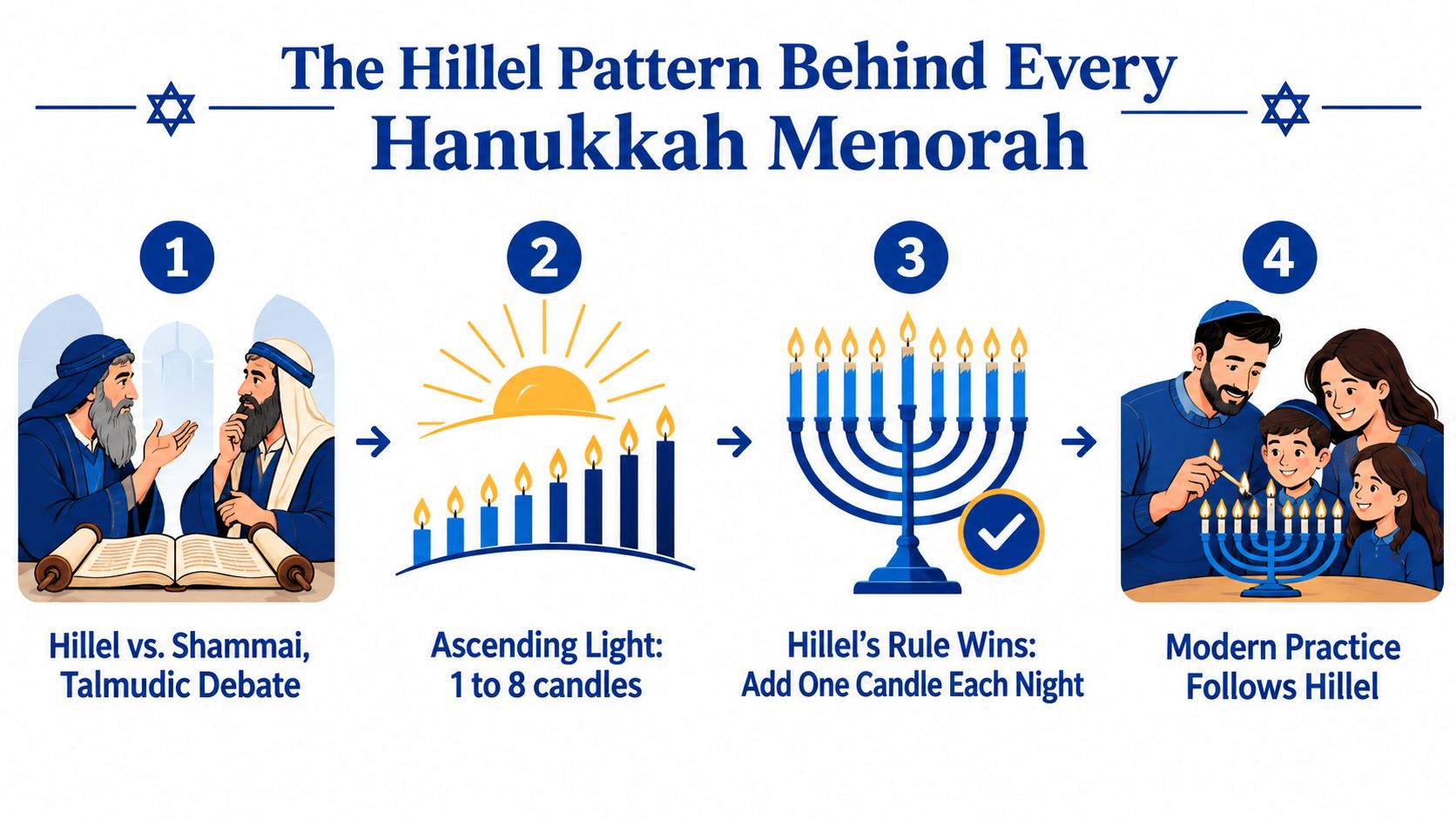
The sequence you use tonight comes from an old rabbinic debate, not a modern shortcut. The Babylonian Talmud, Tractate Shabbat 21b, preserves the discussion between Hillel and Shammai, and the Hillel approach became the accepted practice because it moves upward rather than downward Britannica. So the pattern is simple: 1 candle on night one, 2 on night two, all the way to 8 on the final night, not counting the shamash.
Why the ascending order won
Shammai's view started with eight candles and reduced one each night. Hillel's view began with one candle and added another each night, matching the idea of increasing holiness and treating the miracle as something that grows across the festival The Henry Ford. That is why the modern pattern feels so natural once you know the tradition behind it.
Hanukkah remembers the rededication of the Second Temple after the Maccabean victory over the Seleucids in 164 BCE, and later rabbinic tradition linked the eight-day observance to a one-day supply of consecrated oil burning for eight days The Henry Ford. The candle pattern reflects that same rise in light, one night at a time.
For a quick visual reference, a chanukiah guide helps show how the candle row and the shamash are arranged together.
Practical rule: If you remember only one thing, remember this, Hanukkah adds light as the holiday continues.
Across the full holiday, the sequence creates 36 festival candles in total, plus 8 shamash candles, for 44 total lights when the helper candle is counted The Henry Ford. If you are teaching the holiday to someone new, that total makes the pattern easier to picture. It shows that the custom is not just “light more each night,” but a careful sequence with a clear rhythm.
Setting Up the Menorah and Lighting the Right Candle Each Night
At first, the setup seems backward, then it makes sense. The festival candles go into the menorah from right to left as the nights progress, but you light them from left to right, so the newest candle is lit first. The shamash sits apart from the main row, and it is the candle used to kindle the others.
Reading the menorah without second-guessing yourself
On the first night, place one festival candle at the far right. On the second night, add the new candle immediately to its left, then light the newest one first. By the time you reach night eight, the row fills from right to left, while lighting still starts with the candle farthest left, because that candle is the newest one that evening.
If you are looking at an empty menorah and wondering whether the direction is wrong, the pattern is simple:
| Night | Festival Candles | New Candle Placement | Lighting Order |
|---|---|---|---|
| 1 | 1 | Far right | Light that candle first |
| 2 | 2 | Left of the first candle | Light the newest candle first |
| 3-7 | 3-7 | Add each new candle to the left of the existing row | Light newest to oldest |
| 8 | 8 | Far left becomes newest | Light far left first, then move right |
A practical question comes up often at home and in community spaces. If a candle was knocked out of order the previous night, do not rebuild the holiday in your head from scratch. Return to the correct count and placement for the current night.
The visual trick is simple, the candles accumulate right to left, but the flame moves left to right.
That is the part many people mix up under pressure, especially when guests are watching. Once you separate placement from ignition, the ritual becomes easier to perform and easier to explain.
At a public gathering, that same clarity helps the host assign the lighting without confusion. One person can place the candles, another can hold the shamash, and everyone can see that the order is about sequence, not symmetry.
Blessings, Timing, and the Half-Hour After Nightfall
The candle order matters, and so do the words around it. The usual pattern is to say the blessings before lighting the first candle each night, and Shehecheyanu is said on the first night or the first time you light in a new home. That turns the moment into gratitude, not just a sequence of actions.
Timing rules that keep the ritual aligned
The candles should stay lit for at least half an hour after nightfall Chabad. On Friday, the menorah is lit before Shabbat candles. On Saturday night, lighting waits until after Shabbat ends, which keeps the holiday order intact and respects the weekly rhythm of Jewish practice.
If a candle goes out before the half hour is over, relight it without a blessing. Then check the custom your household or rabbi follows, since communities can differ on details, especially when a flame fails before the required time. That rule gives people something concrete to do in the moment, instead of leaving them to guess.
A small habit helps on busy evenings: set the candles out before sunset, then light only when the timing fits the night you are in.
It also helps when dinner runs late or children are impatient. The ritual feels more settled when the timing is clear, and that steadiness is part of what makes the menorah meaningful year after year.
Ashkenazi, Sephardi, and Mixed Audience Customs
At a mixed Hanukkah event, the order can be familiar and still vary by tradition. A host should not assume one household method fits every guest Chabad.
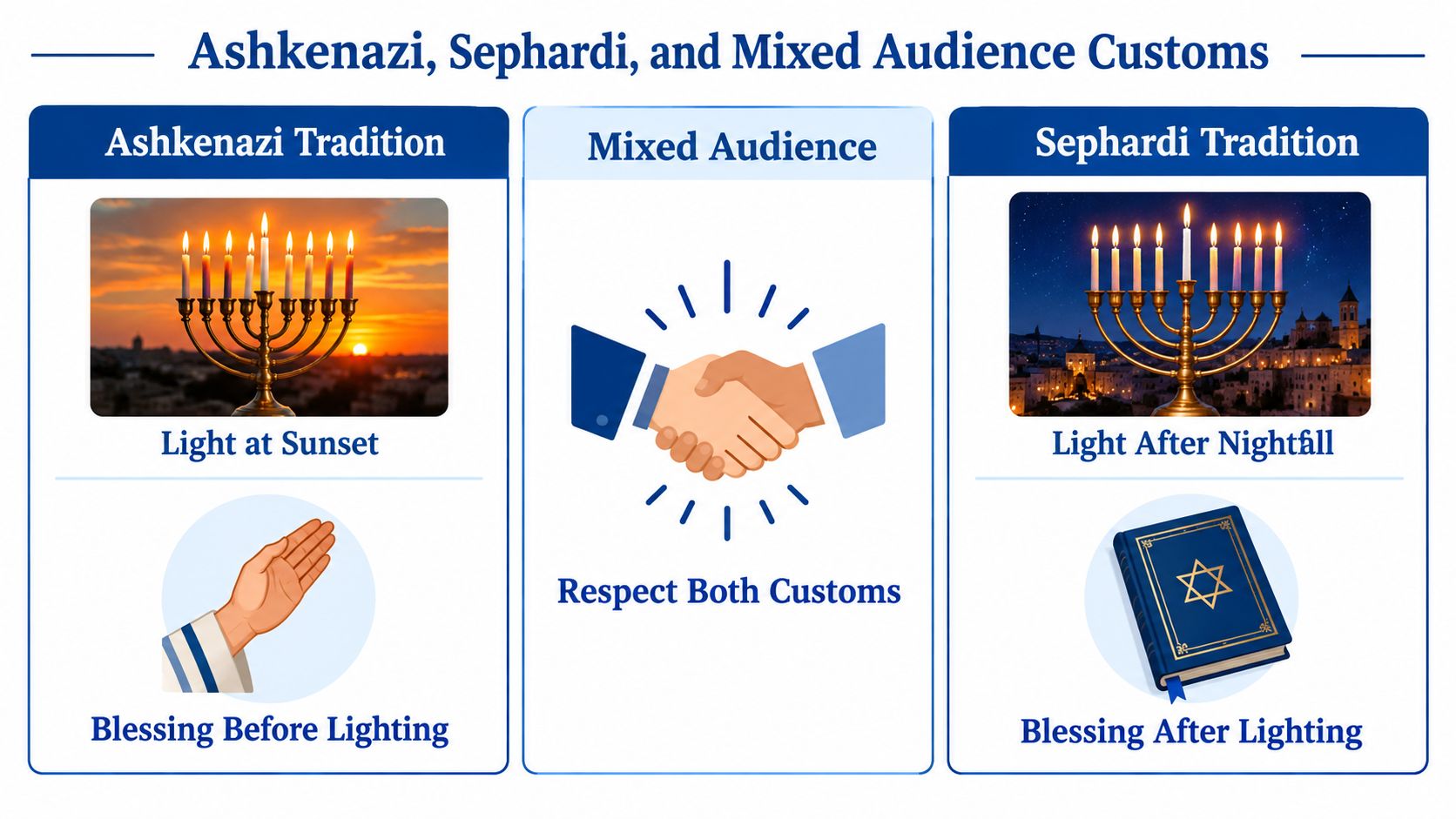
How the customs differ in practice
In practice, the difference shows up in the helper flame. Chabad notes that Ashkenazi practice generally lights the shamash first and uses it to ignite the holiday candles, while Sephardi practice may use a separate helper flame to light the holiday candles and light the shamash afterward A comparison chart showing Ashkenazi and Sephardi Hanukkah candle lighting customs for diverse audiences.. In a synagogue, school, JCC, or public ceremony, that changes who holds what and when.
For hosts, the simplest approach is to decide the format before guests arrive.
- Identify the audience: Ask whether the gathering is mainly Ashkenazi, Sephardi, mixed, or a public observance.
- Clarify the purpose: Say whether the lighting is a ritual observance, an educational demonstration, or a communal symbol.
- Assign the role: Decide who lights, who holds the helper flame, and who explains the sequence to the room.
- Keep language respectful: Present both customs as valid traditions, not as one being corrected by the other.
That kind of preparation prevents confusion when people arrive with different expectations. It also keeps the focus on the menorah itself, rather than on avoidable awkwardness over whose custom is being followed.
Translating the Sequence to Electric and Display Menorahs

Electric Hanukkah menorah options solve a problem that home guides often skip. Public displays don't always allow open flame, so the core challenge becomes preserving the one-through-eight progression in a format people can still read instantly. That's why LEDs, auto-lighting schedules, and individual switches matter so much in institutional settings.
Keeping the nightly progression visible
A good display menorah should still show the rise from one light to eight lights across the holiday, even if it's not burning wax. Menorah offers illuminated LED display menorahs with multicolor light options, dual-sided illumination, and individual switches, along with size options from tabletop units to larger indoor and outdoor installations. It also offers auto-lighting features that can preprogram the nightly progression, which helps when staff can't be on site every evening.
That kind of setup is useful in places where the audience views the menorah from more than one direction. It also helps when a public display needs to stay simple for passersby, because the visual message stays clear without requiring someone to stand there with matches.
Ceremonial or symbolic
This is the question institutions need to answer before they buy or install anything. A display can be intended as a ceremonial observance or as a symbolic public display, and the label should say which one it is. That distinction matters because people interpret the lights differently depending on the setting.
For some hosts, a compact display on a bimah makes sense. For others, a larger outdoor menorah serves the purpose better because the sequence is visible from a distance and the nightly change is easy to follow. The tool should match the job, not the other way around.
Safety, Weather, and Venue Protocol for Public Displays
A kitchen-table menorah and a lobby installation raise different questions. Public displays have to satisfy fire codes, weather, staffing, accessibility, and clear sight lines, and those conditions often make electric illumination the safer choice. PBS notes the use of electric menorahs in public displays because open flames create safety risks, and venue hosts need to plan with that in mind.

What a venue should check before the first night
A public protocol starts before the lights go on. The team should know who activates the display each night, who watches it during the burn window, and how the routine changes if wind or rain affects the plan. If the display is outdoors, the setup should also make it clear whether the lights are being used ceremonially or symbolically.
PBS specifically notes electric menorahs in public displays because of fire risk, and that matters in hospitals, shopping centers, campuses, hotels, and municipal plazas. In those settings, weather-resistant construction and secure mounting are part of basic planning. Menorah's public-display products are built for indoor and outdoor use, with quick-assembly designs and weather-resistant construction intended for repeated seasonal use. For hosts who need a larger installation, a larger outdoor menorah can fit the space better and keep the sequence visible from a distance.
A simple venue checklist keeps everyone aligned:
- Confirm the power plan: Make sure the display can be activated on schedule without improvising each night.
- Secure the base and mounting: Prevent wobble, tipping, or accidental contact from foot traffic.
- Plan for weather: Decide in advance what happens if rain, wind, or site restrictions make open flames impractical.
- Post clear signage: Tell visitors whether they are seeing a ritual display, an educational setup, or a symbolic installation.
- Assign one accountable attendant: Someone should know the nightly routine, even if the display is automated.
If the environment makes candles unsafe, the display should change format, not disappear.
That is the practical balance public hosts need. The tradition stays intact through the sequence and the meaning, while the venue remains safe and functional.
Quick Reference and Common Questions for First-Time Lighters
The shortest way to remember the hanukkah candle lighting order is this, place the new candles from right to left, then light them from left to right, with the shamash separate. The newest candle always gets lit first, and the row grows one candle at a time through the eight nights.
If you forgot to light one night, don't turn it into a crisis. Pick up with the correct number of candles on the next night and continue the sequence. If you're trying to light earlier than nightfall in a pinch, that usually won't fit the standard timing, so check the timing rules used in your home or community first.
Electric lights can be the right choice for a public display, but they're not the same thing as a real flame menorah. In a venue setting, they're often used as a safe, visible way to show the holiday's nightly progression, especially where open flames aren't practical.
Children usually understand the shamash best when you describe it as the helper candle. It's the candle that lights the others, not one of the festival candles itself, and that small distinction helps them see why the menorah has a separate light.
Hanukkah is built around adding light, not performing the night perfectly from memory. If you keep the sequence, honor the timing, and treat the custom with care, you're already doing the work the holiday asks for.
Menorah helps households, synagogues, and public venues plan Hanukkah displays with the right balance of tradition and practicality. If you want a clearer setup for this year's menorah, visit Menorah to explore display options, lighting resources, and public-event solutions that fit your space.


