Apply For Shluchim/Wholesale Account Here


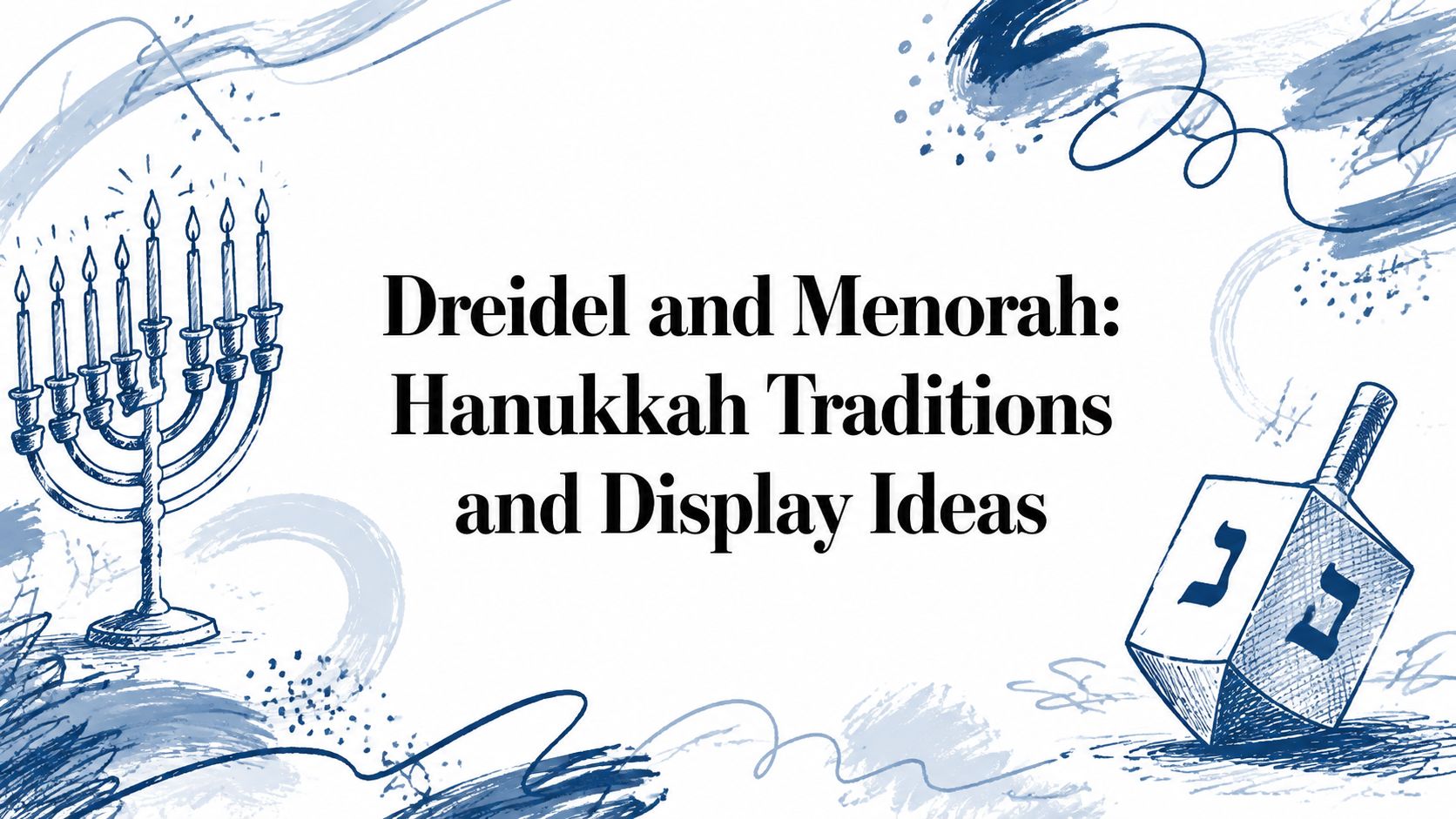
Dreidel and Menorah: Hanukkah Traditions and Display Ideas

A community Hanukkah gathering is about to begin. Families are arriving with coats and plates of holiday food, children are settling around tables with dreidels, and staff members are checking a large outdoor menorah before the first blessing. The flames need to be visible, the game area needs to stay orderly, and the schedule must respect the actual lighting time rather than the convenience of the event program.
A well-planned dreidel and menorah display gives each tradition its proper place. The menorah serves as the spiritual focal point and makes the miracle visible to the wider community. The dreidel creates a hands-on activity that helps children and adults participate through play, conversation, and shared memory. Combining them successfully requires more than attractive decoration. It calls for thoughtful placement, reliable equipment, clear instructions, weather planning, and careful attention to Jewish observance.
Table of Contents
- The Heart of Hanukkah Celebrations
- Historical Roots of the Dreidel and Menorah
- How the Menorah and Dreidel Work in Practice
- Choosing the Right Menorah and Dreidel for Your Event
- Planning Combined Displays for Public and Private Gatherings
- Your Hanukkah Display Planning Checklist
The Heart of Hanukkah Celebrations
As dusk settles over the gathering, families cluster near the large menorah. Oil or candle flames flicker against the winter sky, while the nearby tables fill with the clatter of wooden and plastic dreidels. Children exchange gelt, adults explain the Hebrew letters, and the crowd grows quiet when the blessings begin. Afterward, the sound returns, with laughter, spinning tops, warm food, and conversations between people who may not have met before.
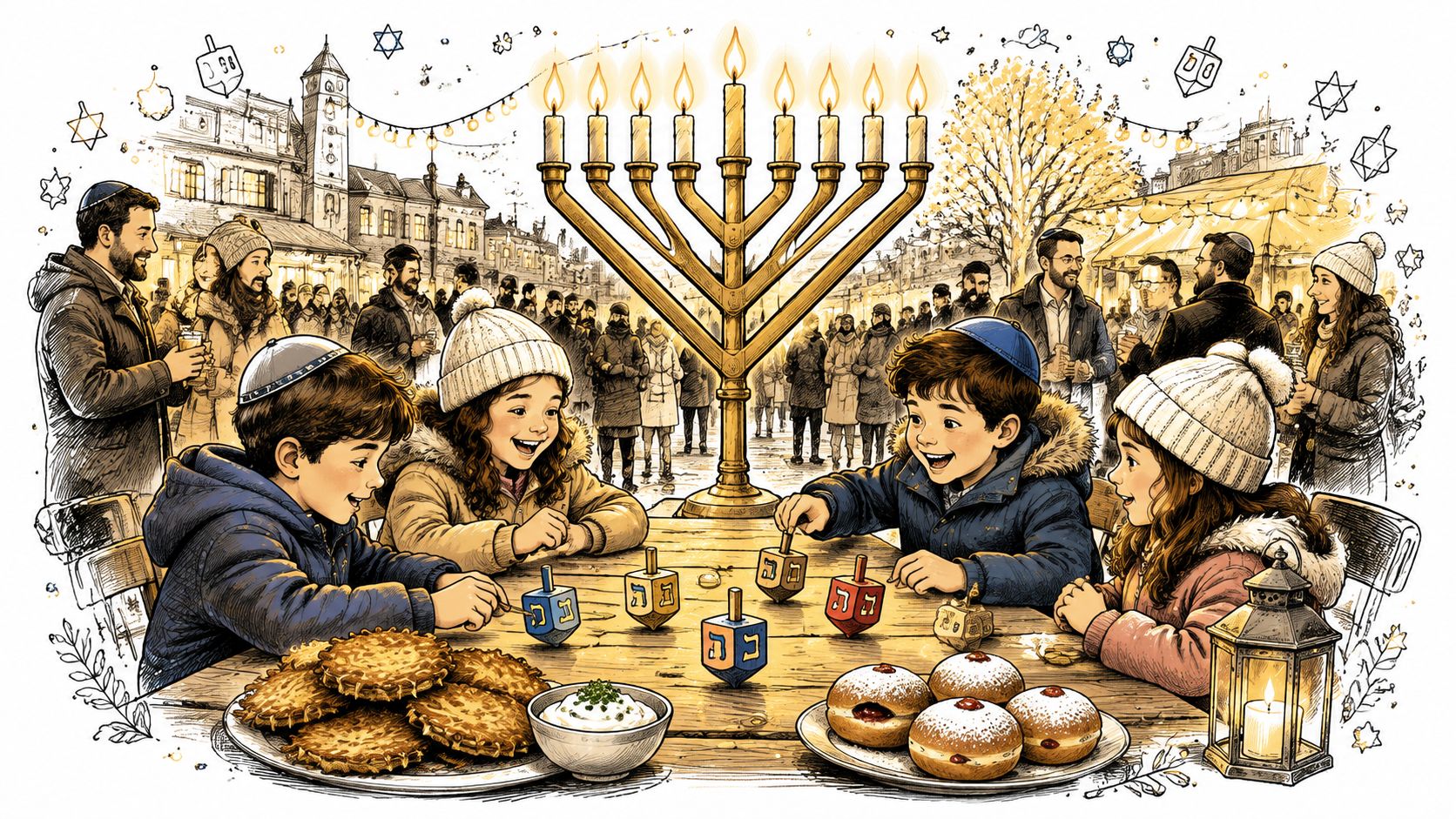
The menorah and dreidel serve different purposes, and that distinction helps planners design better events. The menorah's lights communicate the holiday publicly. Its placement, visibility, and lighting schedule deserve the same care given to the central ceremony itself. A dreidel station, by contrast, invites movement and participation. It works best where guests can gather without blocking the view of the menorah or creating a hazard around flames, cords, or crowded walkways.
Two symbols with complementary roles
The menorah brings attention to remembrance and public observance. Families may light at home, while institutions and public venues often create a communal moment around a display. The ceremony gives the gathering a clear center and a rhythm that can guide announcements, blessings, songs, and food service.
The dreidel turns history into an activity. A child who learns that Nun, Gimel, Hey, and Shin represent different game instructions is also encountering Hebrew letters and a holiday story. Adults can use the game to explain why the dreidel became associated with Hanukkah without turning the event into a lecture.
Practical rule: Keep the menorah ceremony visually central, but make the dreidel area easy to find, comfortable to use, and active before and after the lighting.
A strong event doesn't treat the dreidel as a decorative prop or the menorah as background scenery. It gives each object an appropriate setting. Place the menorah where guests can see it and where staff can supervise it. Place dreidel tables nearby, but not so close that spinning pieces, food, coats, or excited children interfere with the lighting area.
Designing a welcoming shared experience
Families often arrive at different times and know different levels of observance. A short printed explanation can identify the shamash, explain the order of lighting, and give the basic dreidel rules. Volunteers can invite newcomers to play without assuming they already know Hebrew or the traditional customs.
Food, music, and gelt add warmth, but the display should remain understandable even in a busy setting. The most memorable gatherings usually balance ceremony with participation. Guests first understand what they're seeing, then receive a simple way to join in.
Historical Roots of the Dreidel and Menorah
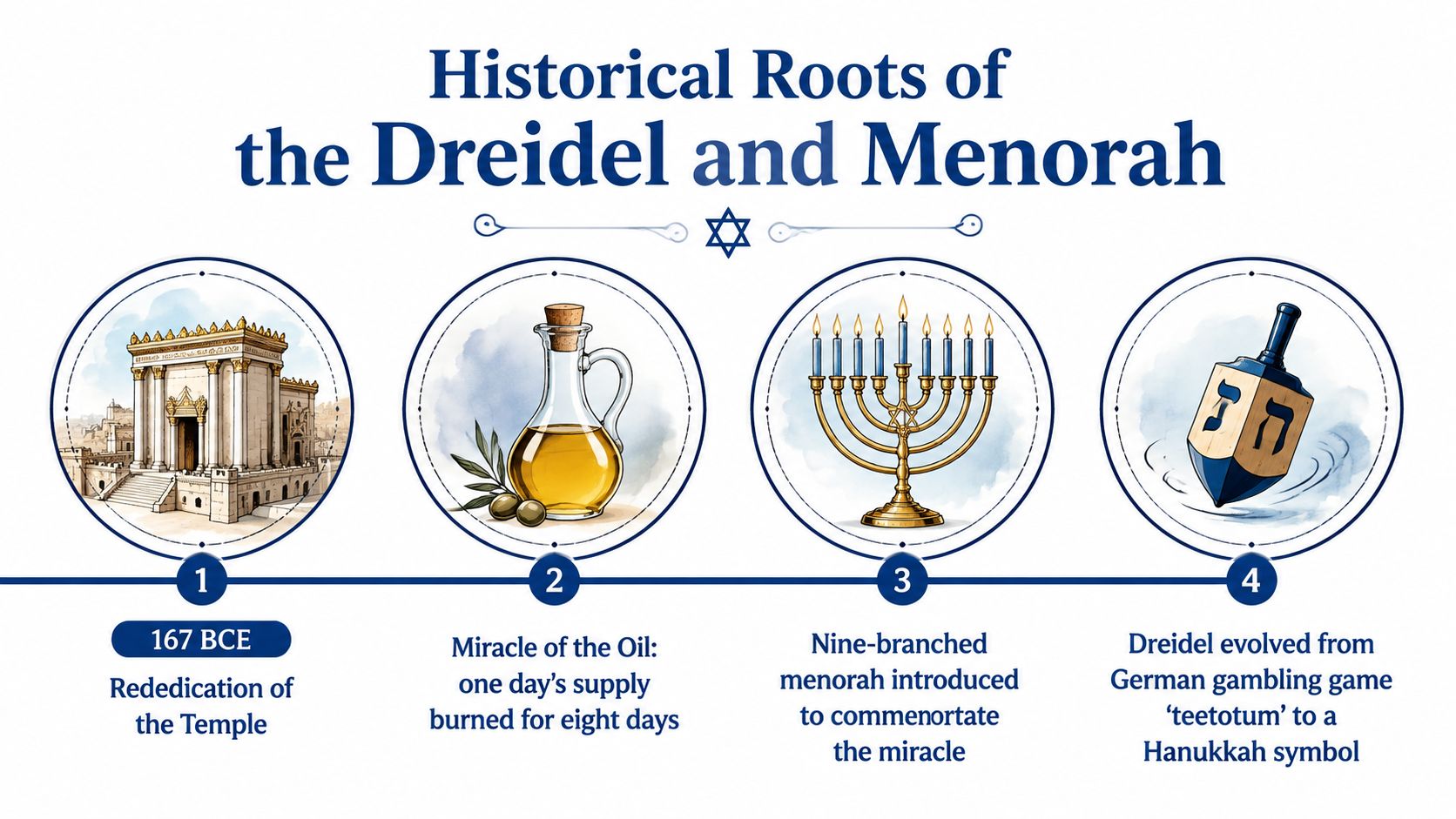
The menorah's story reaches back to ancient Jewish worship. The Temple menorah was a seven-branched symbol associated with the First Temple era and is described as one of Judaism's oldest symbols, as well as the Western world's oldest continuously used religious symbol, according to this historical overview of menorah traditions. The Hanukkah menorah, known as a hanukkiah, developed later and has nine branches, not seven.
That difference matters at public events. The ancient Temple menorah and the Hanukkah hanukkiah are related symbols, but they aren't interchangeable fixtures. The hanukkiah holds eight holiday lights and a separate shamash, or helper light. The shamash has a practical role because it is used to light the other lights and is positioned distinctly from them. For a clear visual explanation, see this guide to the difference between the Temple menorah and the Hanukkah menorah.
From the Temple story to the Hanukkah light
Hanukkah remembers the Maccabees' victory and the rededication of the Temple. The holiday's lighting tradition reflects the account of oil lasting for eight days, which is why the hanukkiah adds a new holiday light on each night. The nine-branched form likely took shape among German Jews in the Middle Ages, while the practice of lighting eight lamps plus a shamash became formalized in the second century CE, as described in the historical source above.
The design therefore carries meaning through its structure. Eight lights represent the holiday's progression, while the shamash remains functionally separate. A display maker who places all nine lights in an indistinguishable row may create a visually attractive object, but the fixture should still make the helper light easy to identify.
How the dreidel became a holiday symbol
The dreidel is tied to a historical sequence that began in 164 BCE, when the Maccabees reclaimed and rededicated the Temple after victory over the Seleucid Empire, as explained in this account of the dreidel's Hanukkah connection. Later tradition connects the spinning top with Jewish learning under oppression. The story describes Jews using a game as a cover when Torah study was restricted.
A traditional dreidel has four sides, each marked with a Hebrew letter:
- Nun represents receiving nothing.
- Gimel represents taking the entire pot.
- Hey represents taking part of the pot.
- Shin represents contributing to the pot.
Together, the letters encode “Nes Gadol Haya Sham,” meaning “a great miracle happened there.” In Israel, the wording traditionally uses a different final letter because the phrase refers to the miracle happening here. For public events, the important point is that the dreidel is not merely a seasonal toy. Its letters connect a simple game to memory, language, survival, and the holiday's miracle narrative.
How the Menorah and Dreidel Work in Practice
A public display becomes easier to manage when the team understands the rules that shape its physical design. The eight holiday lights must sit in a straight, even line, while the shamash remains distinct. The required fuel should be sufficient for the lights to burn for at least 30 minutes after nightfall, according to the practical instructions for lighting a menorah.
The lighting sequence follows a predictable pattern. On the first night, the light is placed at the rightmost position. Each night adds one light to the left, and the newest light is lit first, moving from left to right. The shamash lights the holiday candles, and the appropriate blessings are recited before lighting.

Turning the rules into a reliable setup
For an event team, the nightly process can be written as an operating card:
- Prepare the fixture. Confirm that the shamash is visibly separate and that the eight holiday positions form an even line.
- Place the lights. Add the required number for that night from right to left.
- Check fuel and stability. Make sure each candle or oil cup can support the required burning time and that the fixture won't tip.
- Light with the shamash. The newest holiday light is lit first, proceeding from left to right.
- Recite the blessings. Assign a knowledgeable leader and provide a microphone if the gathering is large.
- Protect the ceremony. Keep guests, decorations, coats, and food away from open flames.
The lighting order affects spacing and access. A fixture that makes it difficult to reach the newest light can encourage mistakes, especially when the menorah is tall or positioned behind a barrier. Staff should rehearse the process before guests arrive and keep replacement candles, oil, matches, or approved lighting tools in a controlled location.
Making dreidel play easy to join
Dreidel play usually begins with everyone contributing a coin, candy, or another agreed token to a shared pot. Players spin in turn and follow the letter that lands face up. Nun means no change, Gimel means taking the pot, Hey means taking part of it, and Shin means adding to it.
The game scales well because the organizer can use several small tables instead of one crowded station. At a family gathering, one adult can explain the letters while children play. At a public event, signs should show the letters and actions, and volunteers can keep each table supplied with tokens. Choose a flat surface, since a warped or soft table makes a dreidel wobble and frustrates new players.
Dreidels are usually small precision objects. Museum records include examples measuring 1.8 cm high by 1.3 cm in diameter and another listed at 3.4 × 1 × 1 cm, as shown by the Jewish Museum collection record for dreidels. Wood and silver are common traditional materials. Dense construction can produce a steadier spin, while lightweight plastic may be easier to replace and distribute.
For broader event logistics, planners can also consult this event production overview for organisers, particularly when the ceremony involves staging, staffing, sound, access routes, and site coordination.
Choosing the Right Menorah and Dreidel for Your Event
The right equipment depends on the setting, audience, supervision, and ceremony. A home gathering can prioritize warmth and tactile materials. A public plaza needs visibility, stability, controlled access, and a plan for changing weather. Indoor venues may permit candle or oil use under their safety policies, while outdoor locations often require additional review of wind exposure, electrical connections, anchoring, and public access.
Oil and candle fixtures offer a traditional appearance and a visible flame, but they require active supervision and careful fuel planning. LED fixtures avoid open flame and can support public display needs where fire codes or venue policies restrict burning lights. An electric display should be understood as a display solution, not automatically as a substitute for the religious lighting practice. Consult the event's rabbinic adviser and the venue's safety officer before finalizing the arrangement.
Material choices for dreidels
Wood gives a classic feel and can withstand repeated family use when finished properly. Plastic is lightweight, easy to distribute, and practical for large children's activities, though thin pieces may wear quickly. Metal can feel substantial and decorative, but its weight and edges deserve attention around young children. Glass is better treated as a display object than a general game piece because breakage creates an avoidable hazard.
The best choice also depends on how the dreidel will be used. A craft table may need inexpensive, replaceable pieces. A formal reception may use a smaller number of carefully selected dreidels. For a visible themed installation, a three-foot LUX Display Dreidel can serve as a decorative focal point rather than a tabletop game piece.
Match the fixture to the event
| Event Type | Recommended Menorah | Recommended Dreidel | Key Considerations |
|---|---|---|---|
| Family gathering | Tabletop candle or oil fixture, subject to household practice | Wood or child-safe plastic | Keep flames supervised and use a stable, flat game surface |
| School or community room | Approved candle fixture or LED display | Durable plastic or rounded wood | Provide visible instructions and separate play from the lighting area |
| Public plaza | Weather-resistant display with secure anchoring | Large decorative dreidel plus supervised tabletop stations | Review fire rules, electrical access, wind exposure, and crowd flow |
| Hotel or shopping venue | Bright LED display suited to the site | Decorative feature with replaceable play pieces | Coordinate with security, facilities, cleaning, and guest movement |
| Vehicle or mobile display | Vehicle-rated fixture with secure mounting | Decorative dreidel used at the destination | Confirm mounting, power, transport, and removal procedures |
Inspect equipment throughout the holiday. Check fasteners, stands, cords, candle holders, oil cups, and lettering. Outdoor fixtures should resist seasonal exposure, but no product should be left without a site-specific weather and safety plan. Portable displays also need enough weight or anchoring to remain stable without becoming difficult for staff to move.
Planning Combined Displays for Public and Private Gatherings
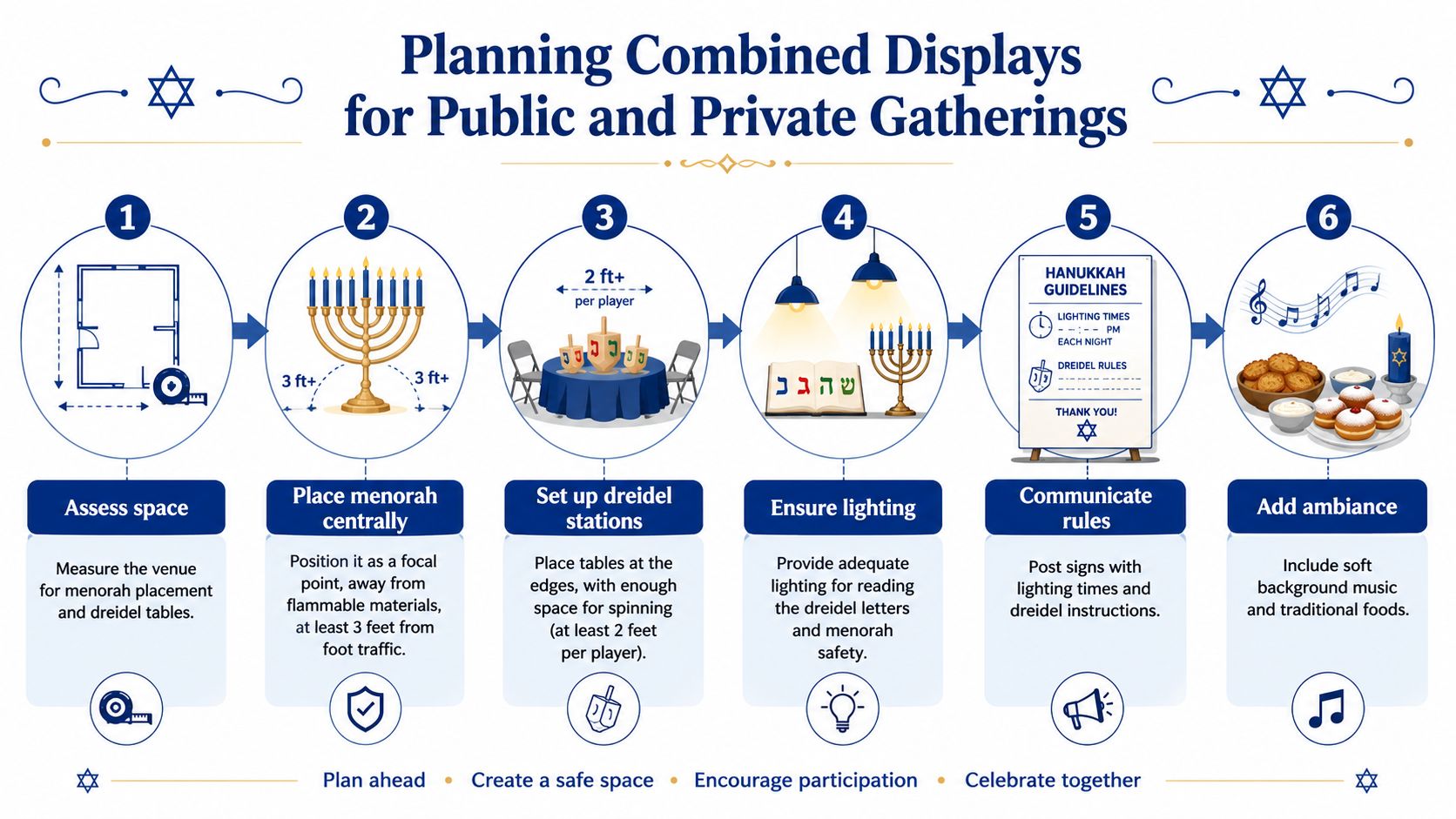
Start with the site, not the decorations. Mark the menorah's position, the lighting leader's standing area, guest viewing zones, dreidel tables, food service, exits, electrical routes, and staff access. The menorah should read as the central ceremonial element, while dreidel activities should sit close enough to feel connected but far enough away to prevent crowding during the blessings.
Build the floor plan around movement
Place dreidel tables at the edges of the main viewing area. Children need room to sit, spin, retrieve pieces, and leave without crossing the lighting zone. Use table signs with the Hebrew letters and game actions, and appoint volunteers to explain the rules rather than relying on one announcement.
For an outdoor gathering, inspect the location at the actual planned lighting time. Winter darkness, glare, wind, wet surfaces, and temporary power routes can change how guests experience the display. Use stable bases, protected connections, weather-appropriate housings, and barriers that guide people without making the menorah feel inaccessible. Keep combustible decorations and food service away from open flames.
Treat Shabbat timing as a fixed operational constraint
The timing becomes especially important when Hanukkah overlaps Shabbat. For 2026, Hanukkah begins at sundown on Friday, Dec. 4, with the first candle lit before Shabbat candles. The final candles are lit on Friday afternoon, Dec. 11, before Shabbat candles, and the holiday ends on Saturday, Dec. 12, according to the Hanukkah 2026 FAQ and schedule guidance.
This means an institution can't program the display for its usual evening event. Staff should confirm the local lighting schedule with a qualified Jewish authority, arrange access before Shabbat, and decide who will prepare or supervise the display. A public electric display may remain useful for visibility, but the same guidance states that electric lights are for display purposes when a real menorah is lit as well. Event planners should therefore separate ceremonial planning from decorative automation.
Schedule the religious requirement first. Build the public program around it, not the other way around.
Create a contingency plan
Fire codes may prohibit open flames in a particular venue. In that case, use an approved electric display for the public setting and communicate clearly with the event's religious adviser about the separate ceremonial lighting. If rain, high wind, or a power fault makes the planned setup unsafe, pause the display rather than improvising with unsecured flames or exposed connections.
A staff briefing should cover emergency shutoff, who can move guests, who contacts venue security, and where replacement equipment is stored. Keep the dreidel program flexible. If the lighting ceremony must move indoors, volunteers should be able to relocate the game stations without losing the event's sense of continuity. For a dedicated electric option, planners can review the electric Hanukkah menorah collection while still checking that the chosen fixture fits the venue and observance plan.
Your Hanukkah Display Planning Checklist
A combined display succeeds when the spiritual purpose, guest experience, and operating plan support one another. Use this checklist before opening the doors:
- Assess the venue: Map the menorah, dreidel stations, exits, food tables, audience area, and staff routes.
- Confirm permissions: Ask the venue about open flames, electrical equipment, public assembly, permits, insurance, and accessibility.
- Choose equipment: Match the menorah, dreidels, stands, barriers, lighting, and power supplies to the audience and location.
- Review the calendar: Confirm nightly lighting times and identify any Friday-to-Saturday transition that affects staffing or access.
- Consult appropriately: Ask a qualified Jewish authority about ceremonial details, especially when Shabbat or an electric display is involved.
- Test the setup: Check candle or oil capacity, stability, visibility, cords, fasteners, signage, and dreidel surfaces.
- Prepare for weather: Secure outdoor fixtures and define the conditions that require postponement, relocation, or shutdown.
- Brief volunteers: Assign roles for lighting, guest guidance, dreidel instruction, crowd movement, and emergencies.
- Run the ceremony: Follow the correct placement and lighting order, provide the blessings, and protect the lighting area.
- Keep activities active: Schedule dreidel play before and after the ceremony so guests remain engaged without interrupting it.
- Close responsibly: Extinguish or disconnect equipment according to the venue plan, collect game pieces, inspect the site, and store fixtures safely.
A thoughtful dreidel and menorah plan doesn't need to be elaborate. It needs to be accurate, welcoming, stable, and practical for the people responsible for carrying it out.
Menorah offers indoor and outdoor display menorahs, including illuminated LED and non-lit models in sizes ranging from tabletop units to larger public installations, along with setup resources and accessories. Visit Menorah to review display options for your home, synagogue, community center, venue, or public Hanukkah event.