Apply For Shluchim/Wholesale Account Here


Night by Elie Wielse


Night by Elie Wiesel has been translated into 30 languages and sold in millions of copies according to the United States Holocaust Memorial Museum, which helps explain why a slim Holocaust memoir keeps appearing on classroom lists year after year. If you searched for night by elie wielse, you're almost certainly looking for the correctly spelled Night by Elie Wiesel, a book that is short on pages and enormous in historical weight. For a quick reference on how Jewish observance and public ritual intersect with memory, this guide to Hanukkah candle colors offers useful context.
A first-time reader usually wants three things right away, a plain-English summary, the historical setting, and a sense of why this book still matters. Night gives all three, but it does so through a compressed memoir style that can feel spare, blunt, and emotionally hard to shake. That combination is part of why teachers assign it, and also part of why some readers bounce off it.
Table of Contents
- What You Actually Searched For and Why It Matters
- How an 862-Page Yiddish Manuscript Became Night
- Plot Summary From Sighet to Buchenwald
- Core Themes and Symbols Worth Knowing
- Why Night Stays in Schools Year After Year
- Common Reactions and Honest Critiques
- Where to Read Next and Keep Learning
What You Actually Searched For and Why It Matters
The correct name is Elie Wiesel, not “Elie Wielse,” and the book is Night, first published in English in 1960 after earlier versions appeared in 1956 in Yiddish and 1958 in French, with the English edition condensed to 116 pages from a much larger Yiddish manuscript as documented in the memoir's publication history). That matters because the form of the book is part of its meaning. This isn't a sprawling war novel. It's a tight survivor memoir built for witness, memory, and classroom discussion.
The basic idea is simple. Night follows a Jewish teenager from his home in Sighet into the machinery of deportation, camp life, forced labor, and loss. The book's global reach is also part of its importance, the U.S. Holocaust Memorial Museum says it has been translated into 30 languages and sold in millions of copies in its biography of Wiesel. That scale helps explain why the memoir shows up in schools far beyond Jewish studies or Holocaust history.
Why the misspelling keeps showing up
Searches like “night by elie wielse” usually come from uncertainty about the author's name or the title's capitalization. The safer anchor is simple, Night by Elie Wiesel. Once you've got that right, the rest of the reading becomes easier to follow because you're working with the correct edition history, the correct author, and the right historical frame.
Practical rule: Treat the title, author, and historical event as three separate things. If you mix them together too early, the memoir starts to feel more confusing than it is.
How an 862-Page Yiddish Manuscript Became Night
The publication story helps explain why Night feels so pared back. Wiesel first wrote an approximately 862-page Yiddish manuscript in 1954, a version far longer and more expansive than the slim English memoir most readers know today according to the memoir's publication history). That original scale matters because it shows the book began as a much larger act of testimony before it became a tightly edited memoir.
From testimony to compression
The work kept shrinking. It appeared in 1956 in Yiddish as Un di velt hot geshvign, then in 1958 in French as La Nuit, and finally in English in 1960 as Night as summarized in the memoir facts page. The English edition's 116 pages do not mean the story was small. They show how the memoir was compressed and shaped for a wider audience.
That editorial history changes how the book reads. A longer survivor account can linger over context, chronology, and detail. Night often does the opposite. It moves in fragments, like memory under pressure. That spare style is one reason the book feels immediate, and it also explains why some readers want more explanation or more texture.
A manuscript book definition can help here. It describes a work in its earlier, more complete form before publication trims it or reshapes it for a broader readership. this manuscript book definition makes it easier to see why a memoir can exist in more than one literary shape.
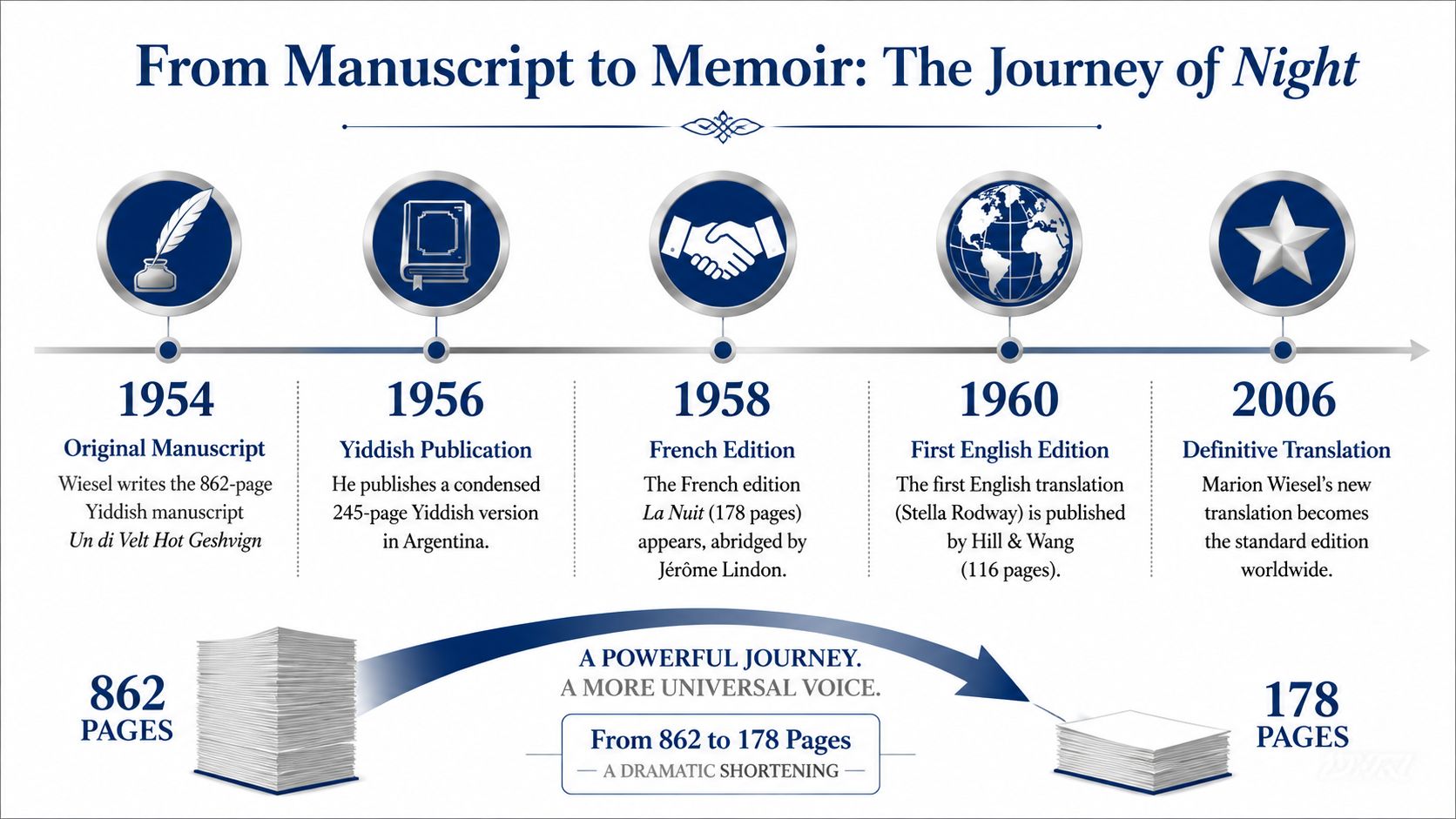
The shortness of Night is not a lack. It is the result of compression, revision, and survival.
Plot Summary From Sighet to Buchenwald
The memoir opens in Sighet, then in Romania, where a Jewish community tries to keep ordinary life intact while danger closes in. Eliezer is still a boy, and his world includes study, family routines, and the presence of Moishe the Beadle, whose warning about what he witnessed is easy for the townspeople to dismiss at first. That early dismissal matters, because it shows how people protect themselves from truth until the truth arrives at their door.
Act one, Sighet and the first warnings
The first movement of the book is about delay. Restrictions tighten, the community is pushed into ghettoization, and ordinary days become organized by fear. Wiesel doesn't lecture about policy. He shows what policy feels like inside a house, inside a family, and inside a teenager's mind. That makes the historical pressure easier to feel without flattening the people who live through it.
Act two, deportation and Auschwitz-Birkenau
The second movement begins with the family's deportation in 1944. The train journey, the arrival at Auschwitz-Birkenau, and the brutal separation from Eliezer's mother and sisters happen fast, which is exactly the point. The camp system destroys family structure before it destroys bodies. Eliezer's bond with his father becomes the emotional center of the memoir, not because it solves anything, but because it gives him one remaining human tie to protect.
The scenes at the selection ramp and in the camp are among the hardest in Holocaust literature because they are so unsentimental. Wiesel keeps the language direct. He does not cushion the violence with explanation. That choice leaves the reader feeling how little control anyone has over what happens next.
Act three, the death march and liberation
The final movement covers the death march, the move to Buchenwald, and the unraveling of survival itself. The father-son relationship, already strained by hunger and exhaustion, becomes even more painful as illness and fear take over. The memoir ends with liberation in April 1945, but not with easy relief. Liberation is real, yet it doesn't erase what has already been taken.
Read the last section slowly. The book's emotional force often arrives after the historical facts are already clear.
Core Themes and Symbols Worth Knowing
Night keeps returning to a few central ideas, and they're easier to track if you attach them to concrete scenes instead of abstract labels. The book is brief, but its thematic structure is dense. Each major symbol does several jobs at once.
Silence, faith, and the problem of speech
Silence is both a repeated image and an ethical problem. Wiesel's memoir is shaped by the sense that language fails under catastrophe, yet the book itself is a refusal to let silence win. That tension is part of why the memoir matters in Holocaust literature and in later public testimony as reflected in Wiesel's biography and legacy. The title itself points to a world where clarity disappears and moral light is hard to find.
Faith becomes fragile in the camp. The hanging of the pipel, the Rosh Hashanah prayer scene, and the line “Never shall I forget that night” force the reader to confront a crisis of belief that doesn't resolve neatly. Readers sometimes want the book to answer whether faith survives. Wiesel gives a more difficult answer. Faith changes shape under pressure, and doubt becomes part of the testimony.
Father and son, love under starvation
The father-son bond between Eliezer and Chlomo is one of the book's deepest emotional structures. It isn't sentimental. Hunger, fear, and exhaustion strain it almost constantly. One of the most devastating moments comes when Eliezer feels numb as his father is beaten, because the memoir shows how camp life can blunt even natural love. That numbness is not moral failure alone. It's also a survival response.
The father's death is so painful because it leaves Eliezer both bereaved and ashamed. In a lesser book, that could become a melodramatic climax. Here, it's quieter and harder.
Dehumanization and the logic of numbers
Dehumanization in Night is not an abstraction. It starts with tattoos, shaved heads, stolen names, and forced labor. The renaming of people into numbers, including A-7713, shows how the camp system works on identity before it works on the body. Once a person is reduced to a number, the world can pretend the person is replaceable.
For readers who want to connect this to other Jewish symbols and ritual objects, it can help to distinguish historical memory from religious objects. A helpful guide on that distinction is this explanation of the Temple menorah and the Hanukkah menorah, which is useful when discussing how Jewish symbols carry different kinds of memory.
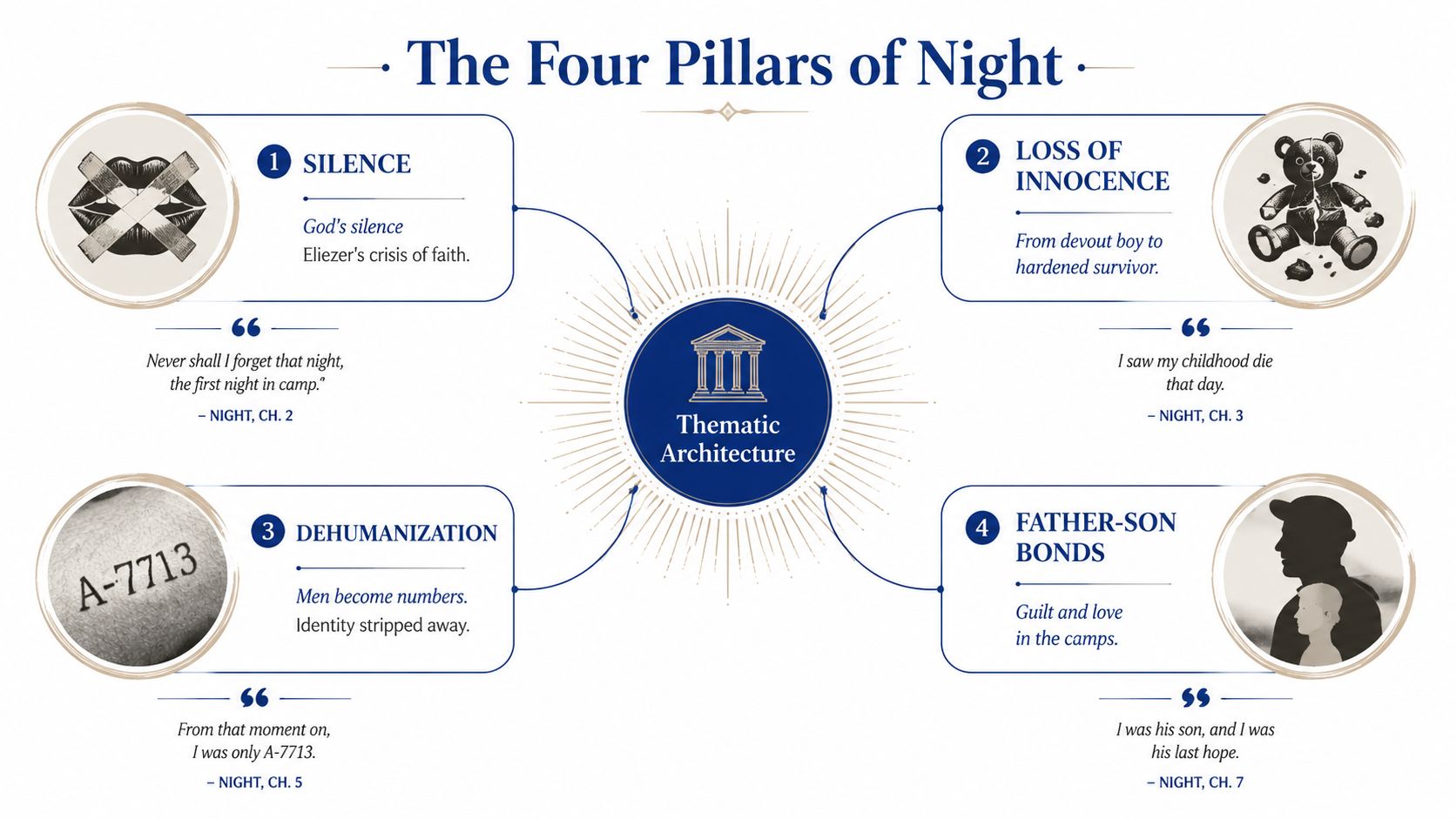
Teaching note: Don't ask only what a symbol means. Ask what it does to the reader's sense of time, faith, and identity.
For educators looking to broaden the conversation about trauma, cruelty, and youth reading, an educator-curated bullying book list can help frame discussions of dehumanization without collapsing everything into one topic.
Why Night Stays in Schools Year After Year
A short book can carry a long classroom life. Night keeps showing up in syllabi because it combines institutional reach, a compact length, and a first-person account that teachers can fit into a crowded reading list. As described in education reporting and the U.S. Holocaust Memorial Museum biography, it remains widely taught in the United States and abroad as described in education reporting and the U.S. Holocaust Memorial Museum biography. For teachers, that matters because the book gives students direct access to witness, without requiring a long secondary text first.
Why it fits classroom use so well
Its teenage perspective is one reason the memoir works so well with adolescents. Textbooks can reduce Holocaust history to dates and terms. Wiesel's voice brings the human cost back into view. That makes it easier to discuss dehumanization, moral collapse, family bonds, and responsibility in a way students can feel, not just memorize.
Here's a simple comparison for classroom use.
| Feature | Night (Wiesel) | If This Is a Man (Levi) | Man's Search for Meaning (Frankl) |
|---|---|---|---|
| Length and format | 116-page memoir in the English edition | Longer testimonial prose | Reflective memoir and psychological argument |
| Classroom effect | Very teachable, direct, and compact | More textured and analytical | More philosophical and interpretive |
| Student entry point | Immediate first-person witness | Slower, more demanding prose | Broader life-meaning framework |
| Common use | Holocaust introduction and discussion text | Advanced comparison text | Ethics, resilience, and meaning |
That difference in style helps explain why readers respond so differently to the book. Some students are drawn to its plain language because it sounds stripped to the bone, like a witness statement rather than a polished literary performance. Others find that same plainness hard to sit with. Teachers often use the memoir beside survivor testimony projects and museum resources so students can hear one voice in the book and compare it with recorded testimony. That pairing keeps Night from feeling isolated on the page.
For classes or synagogue study groups, Menorah's display menorahs and setup resources can support public Hanukkah programming that often accompanies Holocaust remembrance events. It is a practical reminder that Jewish observance and education can share the same communal space without blending into one thing.
Common Reactions and Honest Critiques
Readers often react to Night in three different ways, and it helps to keep them separate. Some people respect the book's historical weight but don't enjoy its literary style. Others accept the style and still find the memoir emotionally overwhelming. A third group thinks the book is over-assigned, especially when it's introduced without enough context.
Why the criticism is not all the same
One common complaint is that the prose feels too sparse. Compared with Primo Levi's more textured writing, Wiesel's English text can seem stripped down, even underwritten. That reaction isn't wrong, but it needs a label. It's a literary judgment, not a rejection of the book's historical importance. The memoir's compressed style is part of its force, but not every reader likes that force.
Another complaint is emotional overload. Some students and parents say the book is too sad, too graphic, or too much for younger readers. Schools have responded in different ways, including content warnings and alternative assignments. In 2023, a Tennessee school board briefly removed the book before reinstating it after public pressure, which shows how contested its place in school reading can be.
A cleaner way to evaluate it
The most useful question isn't whether everyone should love Night. It's whether the book does the specific job it sets out to do. If you're reading for historical witness, it's powerful. If you're reading for layered prose in the style of a long literary novel, you may wish for more. If you're reading while emotionally raw, you may need to pace yourself or choose a different text for the moment.
That separation helps students and adults alike. Historical importance, literary style, and emotional tolerance are not the same thing. Once you stop treating them as one question, your response to the book becomes more honest.
Where to Read Next and Keep Learning
For many readers, the easiest next step is the 2006 Marion Wiesel translation from Hill & Wang. Older editions, including the earlier English translation by Sifton from 1960, still appear in libraries and course references, as reflected in the memoir's publishing record. Start with the edition you can read comfortably, then widen the circle.
A simple reading path
- Read Night first. It gives you the witness and the main historical arc.
- Move to Dawn and Day. Those books extend Wiesel's fictional and philosophical concerns.
- Try The Town Beyond the Wall. It shows an earlier literary voice.
- Finish with All Rivers Run to the Sea. That memoir broadens the postwar story.
Free companion material can help when the memoir feels heavy. The United States Holocaust Memorial Museum, Yad Vashem, and the USC Shoah Foundation's Visual History Archive all give context beyond the page. A memoir and recorded testimony work like two angles on the same event, each clarifying what the other cannot hold alone.
For a different survivor voice from the same historical world, choose The Diary of a Young Girl or Primo Levi's Survival in Auschwitz. They do not replace Wiesel's book, but they sharpen tone, perspective, and survival in different ways.

Keep a small notebook, mark each place name, and read the memoir in two sittings if you can. A second pass often changes the experience.
Jewish ritual objects can also deepen the reading. A dreidel and menorah are not part of Wiesel's memoir in a literal sense, but they help readers think about memory, observance, and how Jewish life survives through objects as well as stories.